Date: 09-Mar-22
Time: 19:00-20:00 (plus a bit extra!)
Attendees: Andrew Hoyt, Andy Whitehouse, Becky Goodwin, Chris Grieve, Ellen Boyle, Gram Davies, Marsha Oza
Notes taken by: Marsha
Notes
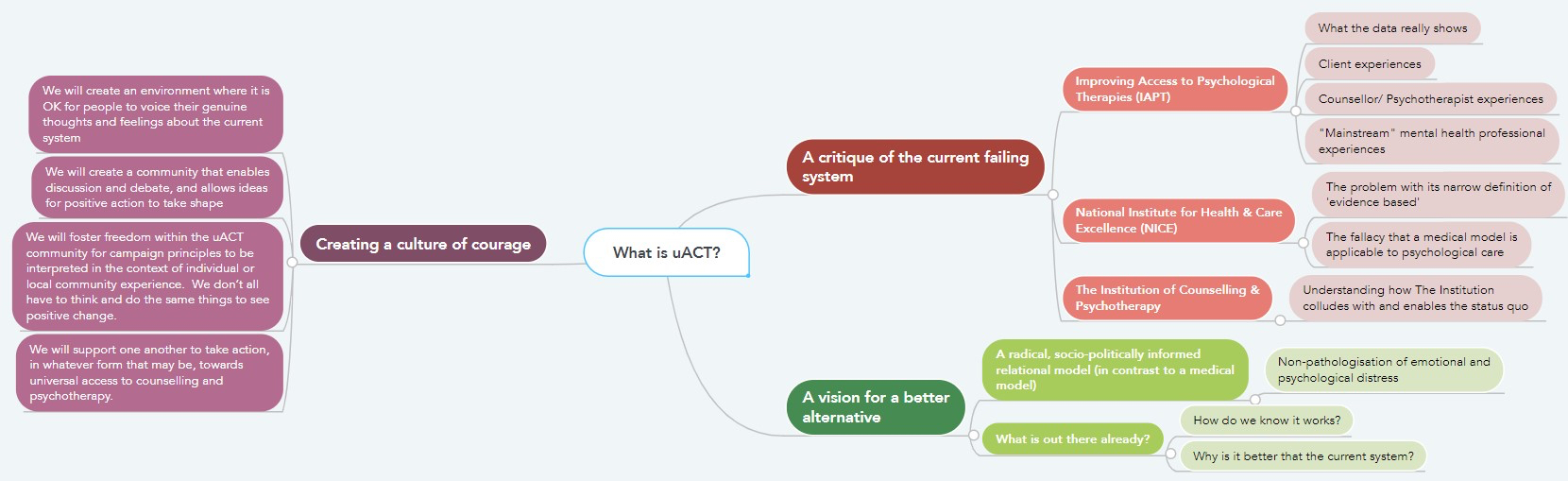
We used the time to meet one another, and share thoughts about the campaign, particularly with regards training/ trainees. Many of these mirrored/ supported ideas from the organising group expressed in the attached graphic (which has been slightly amended since the first iteration following a suggestion from Becky to describe “a radical, socio-politically informed relational model (in contrast to a medical model)”, which I didn’t think anyone would argue with!).
Thoughts from the group about what we’d like to see as follows:
- Sharing information with trainees about how to develop a practice that promotes/ enables universal access. We shared personal experiences of seeking broader learning for ourselves due to personal experiences in trainings where we felt marginalised, or watched others feel marginalised, or wondered about what wasn’t being addressed. Acknowledging that socio-politically located suffering is not individual pathology, and how this often doesn’t show up in training because it doesn’t fit comfortably into traditional theoretical models. A strong feeling that training needs to be radically changed to enable new ways of thinking – about the contexts within which we operate, and about what a meaningful therapy practice looks like. If trainees were raised to develop socio-politically located practices from the outset, could Community Projects form part of developing practices “as standard”? Chris mentioned a counselling café in Sunderland which provides a possible model. Similarly, if trainees knew about things like the Free Psychotherapy Network, they could decide whether to, and how to, include membership into their developing practice. How much time is spent really exploring alternatives to sliding fee scales? Are there better ways for us to open up our services? How can we make a living and take counselling to whole communities? These should be core issues in training.
- Building a support network for trainees who are or want to work in a socio-politically informed, universally accessible way. Several expressed feeling isolated in wanting to think about and develop their practice in ways that challenged the prevailing paradigm of what therapy looks like. Some frustration was shared about therapy as a route to making money (although we also acknowledged the need to make a living). A space to explore these issues and their complexities felt important.
- Universal access to trainings. More openness to trainees and trainers who are not middle class. Training which properly reflects the world, rather than paying lip service to equality, diversity and inclusion as a theoretical construct/ ethical requirement. Some discussion around volunteer placements, and how this creates a barrier to universal access. How might we partner with Counsellors Together UK to support their work on this specifically?
- How could we use social media?
- How could we promote listening skills in communities, so people are empowered to support one another in community (like Samaritans Listening Campaign)?
- How can we influence trainings to be real. Some discussion about elderly training materials, and a feeling that the same old stuff has been trotted out for years without much thought. How can we challenge trainings to be better? Andrew gave us a wonderful vision of revolutionising training, and briefly described what he’s doing with the training her delivers in Brighton. There was general agreement that we’d like to hear more about this (an agenda point for the next meeting, if Andrew’s game!).
- There was some disappointment expressed with the profession, how closed-minded it can be, and how afraid it is of being political. There was a determination in the group that we can do better than this. We talked about how this feeling is not new in the profession (but how it is currently conspicuously ignored in mainstream trainings). Marsha recommended The Making of Psychotherapists, which picks up on this issue, amongst others (full pdf available here: https://www.academia.edu/167397/_2009_The_Making_of_Psychotherapists_an_anthropological_analysis_London_Karnac). Andrew shared a quote from John McLeod, which I include because it struck me as profoundly true: “Counselling and Psychotherapy is like an existential barometer for society.”.
Next Meeting
Becky to organise. Date and time tbc.
 uACT
uACT 